
BLOG · Review: “Yugo Goes to America”
Written by Linda Krnáčová and Sofi Avetisyan
Master Film and Photographic Studies at Leiden University
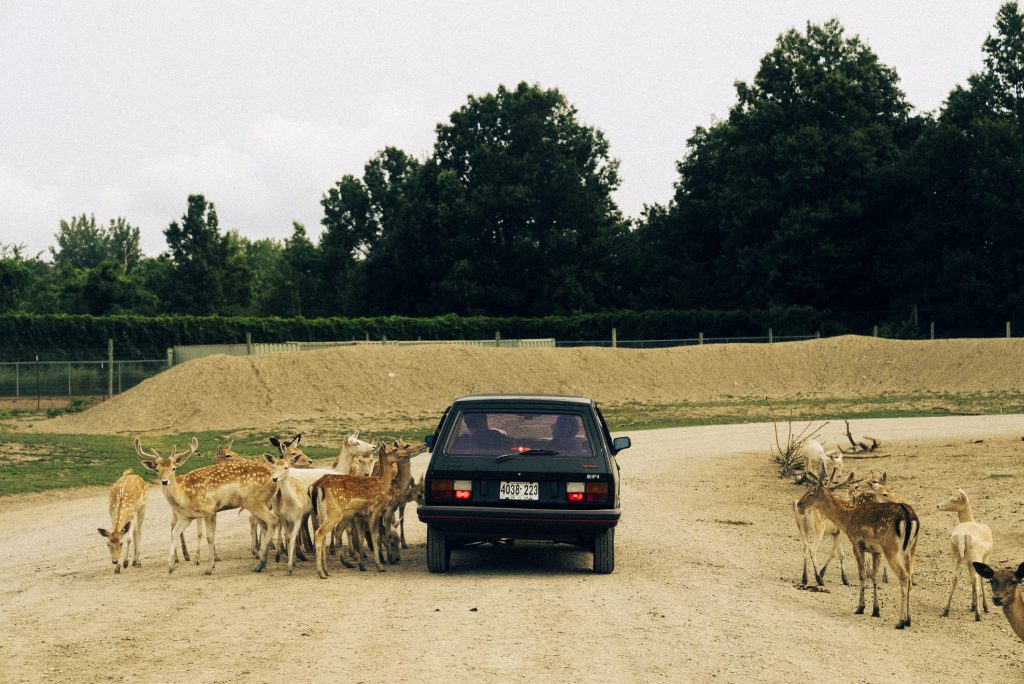
Yugo Goes to America (2026) is a docu-comedy made by three friends from Serbia – Filip Grujić, Aleksa Borković, Aleksandar Blažić – travelling all the way from New York to Los Angeles with Yugo. Yugo is a friend, a dear companion, a co-traveller and, as it happens, a car. A Yugoslav budget car, which was first produced in the 1980s and later exported to the U.S., where, as mentioned in the film, it “became the best-selling European product and Reagan’s America was struck by so-called Yugomania”. However, this excitement didn’t last too long and before he knew it, Yugo received a new title in the U.S., “the worst car in history”. This film traces the history of the export of the Yugo to America, from its first shipment across the Atlantic Ocean, until its import was stopped entirely, due to the Yugoslav Wars in the 1990s. At the same time, the film captures an unforgettable road trip of friends, who must deal with the complications that come with a vintage car, such as the Yugo. This includes breakdowns potential and real, which could sabotage the whole experiment at any moment. You see, Yugo is not a regular car and there are only a few people on this planet, let alone in the U.S., who are able to fix it or provide parts for replacement. However, even though these technical difficulties loom over the entire film, they are also simply seen as a part of the journey; nothing that cannot be fixed or overcome with the help of a few beers, a guitar and a good song. The Yugo might be the worst car out there in the eyes of many, but in this film, it is not seen as a burden, but a blessing. The Yugo is lovingly portrayed with all its uniqueness and quirkiness, capturing all the little details, which make it so special. Moreover, Yugo functions as a connecting link not just between places, but also people. On their journey through the Boonies of America, Filip, Aleksa and Aleksandar encounter amazing people from all walks of life, including mechanics, technicians, or just passersby, who stop to admire Yugo in all his weirdness and glory.
The guiding theme of this year’s edition of the Eastern Neighbours Film Festival is roots, which made us think about where one has their roots, when growing up in a country like Yugoslavia, that no longer exists. Where do people from Yugoslavia feel at home and does a place like home even exist? In this film roots, for example, don’t represent a place, but a feeling, specifically the feeling of connectedness – to people, to places, to bygone eras. It fully embraces the essence of the 1980s, trying to recreate the aesthetics of the era in many shots, almost as if the creators were trying to time travel to a simpler and more nostalgic time – an era, when the Yugo was still the best car on the market and Yugoslavia was still a country untouched by war. Throughout the film it shows how former Yugoslav countries remain close, despite their apparent separation. During one of Yugo’s breakdowns, the filmmakers reach out for help on Facebook, to which two mechanics respond: “Come to our place”, Alen and Hasan, two Bosnian mechanics, say, “We’ll give you the gearbox from our Yugo”. How beautiful it is, that when three Serbians look for help in middle-of-nowhere America, a Bosnian lends a helping hand without hesitation. Even after the collapse of Yugoslavia in the 1990s, the countries, now separated by borders, always seem to have each other’s backs. In the film, the Serbians and the Bosnians talk to each other in their respective languages, while effortlessly understanding one another, sharing the same history, roots, jokes and sense of humour, and most importantly, the same alcohol. As Alen explains in the film, Rakia “is a medicine from Balkans. Back home when you get sick, you just take a shot, you shaved, washed your face with moonshine, you got a toothache – you drink a shot… it cured everything. Only thing that it doesn’t cure is cancer”. It is interesting how he refers to his home as “Balkans” and not Bosnia. Maybe the division of the countries doesn’t have to mean the division of the people.
The exploration of roots can be traced through the Yugo itself as it acts as the main agent within the film, carrying culture, identity and a sense of nostalgia. It becomes both a symbol of what was once Yugoslavia, while maintaining its own unique features and characteristics. Yugo was an attempt of Yugoslavia to establish itself within a foreign and challenging market, to achieve prosperity, and, at least for a while it succeeded, as the Yugo became a celebration of Yugoslav economic prowess. As explained in the film, “the Yugo began being exported to the U.S. and Yugoslavia became the ‘Good Communist’ in the eyes of the West”. During the journey the Yugo maintains its Yugoslav identity and cultural symbolism, while facing an environment as foreign as the immigrants he meets along the way. It shows that, despite the passage of time and shifting of space, people will always try to preserve their cultural background and identity, as their roots will always remain an inherent part of who they are as people, no matter where they go. Yugo Goes to America is a reminder that we all are the stars of our own stories and that we should forever cherish our origins and pass on our traditions, languages and sense of humour. The film shows us that people with the same ethnic and cultural backgrounds are always going to feel connected to each other, even when they’re scattered all around the world. The hard times the Yugo and his passengers encounter during their road trip are embraced and made bearable by connecting with like-minded people. Over and over again, the film shows us that everyday problems, no matter how many or how big they are, can end up bringing us together, either over a beer, a song, a warm hug or a broken-down obscure vintage car. If you’re planning to see this film, be ready to experience human connections and interactions that are only made possible thanks to one singular object – the Yugo – the worst car that creates the best memories; a symbol of what was once powerful but eventually collapsed. Even though the country doesn’t exist anymore and the car has disappeared from the streets, their memory will always have a special place in the hearts of the people who have experienced both their rise and eventual fall.
If you also want to hop on the Yugo, and join the journey of exploration, unity and connectedness, while sharing a laugh with those around you, don’t forget to get yourself a ticket and join us at Filmhuis Den Haag. You will see beautiful cinematography, relatable stories and expand (or refresh) your knowledge about the Yugo, and, most importantly, find out the answer to the filmmakers’ main question that made them embark on this insane journey to begin with: “what does it actually mean to be the worst? How can something be considered the best in one place and the worst somewhere else? Who decides that and does such a title have an expiration date?”
Saturday 7 November 21:45
Sunday 8 November 12:45